
EV Reviews & Launches
Hyundai Ioniq 9 vs. Kia EV9: Which Three-Row Electric SUV Wins?
The market for large family electric vehicles has evolved into a fierce sibling rivalry. This comprehensive 2026 review compares the Hyundai Ioniq 9 and the Kia EV9 to help multi-row buyers choose the best vehicle.
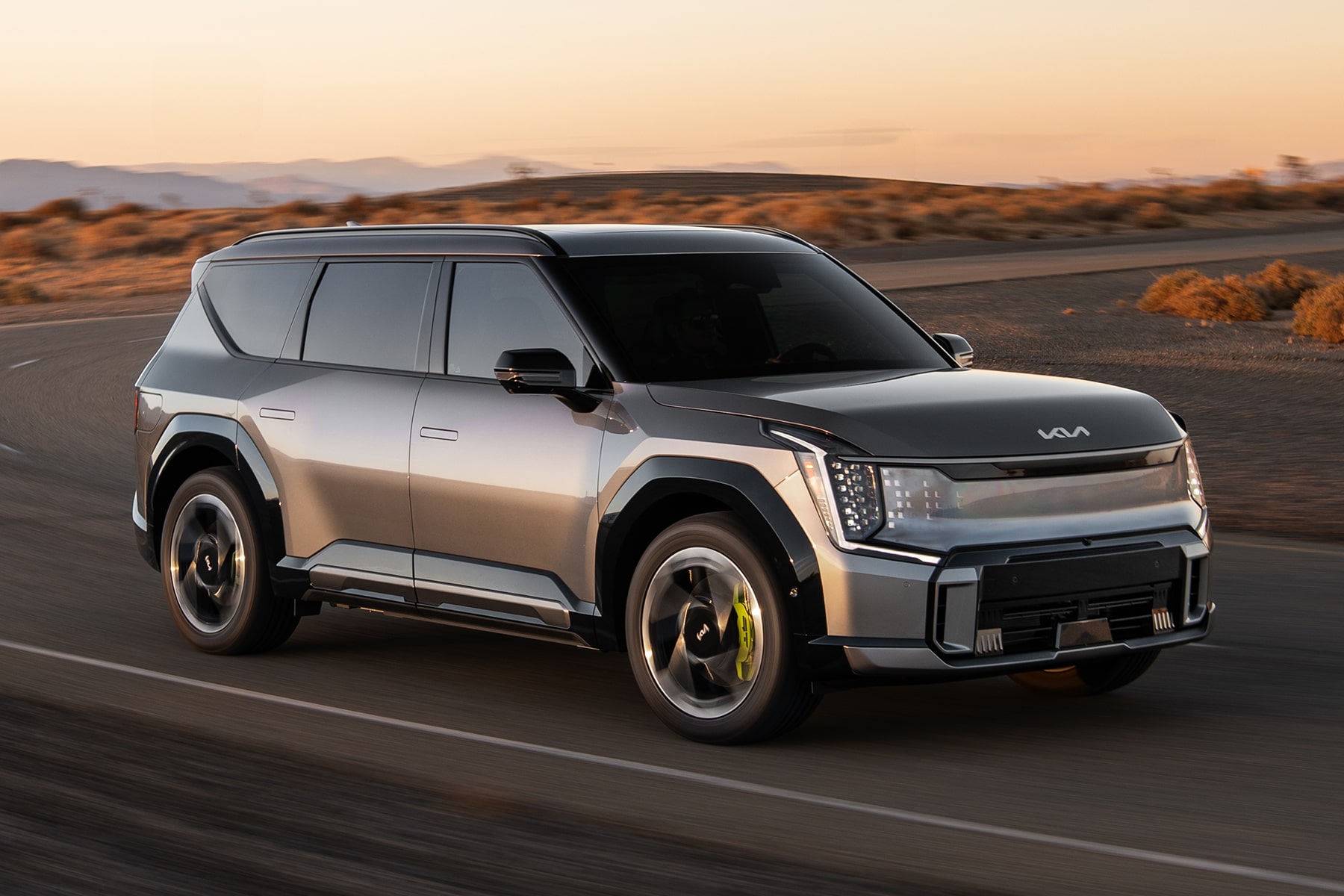
The market for large family electric vehicles has expanded past basic concept designs. For multi-row households looking to abandon internal combustion engines, the search for a true seven-passenger vehicle with uncompromised capability leads directly to South Korea. Built on the same advanced engineering foundation, the Hyundai Ioniq 9 and the Kia EV9 represent the absolute peak of modern family transport.
While these two vehicles share a corporate parent and structural roots, they feature vastly different styling philosophies and interior ergonomics. Deciding between them requires analyzing real-world utility metrics. This head-to-head comparison evaluates their dimensions, real-world battery ranges, towing ratings, and cargo limits to declare an ultimate winner for 2026.
Platform Roots and Exterior Footprints
Both vehicles utilize the celebrated Electric-Global Modular Platform (E-GMP), meaning they benefit from native flat floors and ultra-fast charging capabilities. However, Hyundai has pushed the physical limits of the platform further with the Ioniq 9. The Ioniq 9 features an elongated 123.2-inch wheelbase, which provides a slightly more stable ride quality over rough road joints.
In terms of pure exterior presence, the Ioniq 9 is roughly two inches longer and over an inch taller than the Kia EV9. Kia opted for a boxy, angular, cyber-truck-inspired design that prioritizes a rugged look. Hyundai embraced a sweeping, aerodynamic profile called the "Aerosthetic" silhouette, achieving a low 0.25 drag coefficient when equipped with digital side mirrors.
Interior Space, Comfort, and Cargo Capabilities
Inside the cabin, that extra length gives the Hyundai Ioniq 9 a slight advantage in raw volume. Passengers in the third row get a bit more breathing room, making the rearmost seats viable for adult passengers on extended road trips. Both brands offer optional second-row captain chairs that can swivel or recline fully during charging stops.
When it comes to hauling groceries, sports gear, or vacation luggage, the cargo layout details matter. The Kia EV9 optimizes space directly behind the third row, offering slightly more volume when all seats are occupied. However, when you fold the second and third rows completely flat, the Ioniq 9 takes the lead, unlocking a massive 88 cubic feet of total storage space for hauling large boxes or camping gear.
Battery Efficiency, Range, and Charging Comparison
The most significant engineering divergence shows up in the battery pack capacities. The Kia EV9 utilizes a 99.8 kWh lithium-ion battery pack on its long-range trims, delivering a respectable maximum EPA-estimated range of 304 miles.Hyundai decided to go larger, equipping the Ioniq 9 with a massive 110.3 kWh battery pack as standard equipment for its long-range configurations.
This extra capacity gives the Ioniq 9 an edge on highway journeys, pushing its maximum EPA-estimated range up to 335 miles in the single-motor rear-wheel-drive trim. Because both SUVs utilize an uncompromised 800-volt electrical architecture, their charging speeds are virtually identical. When connected to a 350 kW ultra-fast DC station, both vehicles can replenish their batteries from 10 percent to 80 percent in just 24 minutes.
Performance, Towing, and Driving Dynamics
The driving characteristics of these family haulers are tuned to match their visual styles. The Kia EV9 delivers a slightly firmer, more athletic suspension tune that manages body roll well through tight corners. The premium Kia EV9 GT high-performance variant pushes boundaries even further, delivering sports-car acceleration to the three-row segment. The Hyundai Ioniq 9 prioritizes maximum cabin isolation, utilizing acoustic glass and soft dampers to deliver a smooth ride.
For families planning weekend adventures, towing capabilities are evenly matched. When configured with dual-motor all-wheel drive, both the Ioniq 9 and the EV9 carry a robust 5,000-pound maximum towing capacity. Both vehicles also include an intelligent trailer software mode that automatically estimates trailer weight and recalibrates the driver's remaining range display in real time.
Core Specification Comparison Matrix
Evaluating these mechanical siblings requires comparing their physical limits side by side.
Performance Metric | 2026 Hyundai Ioniq 9 (AWD) | 2026 Kia EV9 (AWD Land) |
Battery Pack Capacity | 110.3 kWh | 99.8 kWh |
Max EPA Estimated Range | Up to 335 miles (RWD) / 304 miles (AWD) | Up to 304 miles (RWD) / 280 miles (AWD) |
DC Fast Charging Time | 10% to 80% in 24 minutes (800V) | 10% to 80% in 24 minutes (800V) |
Maximum Towing Capacity | 5,000 lbs (AWD) / 3,500 lbs (RWD) | 5,000 lbs (AWD) / 3,500 lbs (RWD) |
Maximum Cargo Capacity | 88.0 cubic feet (Seats folded) | 81.7 cubic feet (Seats folded) |
Vehicle Total Length | 199.2 inches | 197.2 inches |
Vehicle Wheelbase | 123.2 inches | 122.0 inches |
The Editorial Verdict: Which Family EV Wins?
Choosing between these two South Korean powerhouses comes down to a choice between style preferences and specific interior spatial needs.
Choose the Hyundai Ioniq 9 if you prioritize maximum passenger volume, maximum highway driving range, and a soft, quiet ride that mimics a high-end luxury lounge. It is the superior vehicle for long-distance road trips where maximizing cargo space is essential.
Choose the Kia EV9 if you prefer a bold, boxy aesthetic, desire a slightly more engaging driving experience, and need a vehicle that fits more easily into standard suburban garage spaces.
Both SUVs represent the absolute pinnacle of current three-row electric automotive engineering, successfully proving that transitioning to clean family transport requires absolutely zero mechanical compromises.
Related Articles
e-Mobility & EVs
Urban Air Mobility: When Will Commercial eVTOL Flights Take Off?
e-Mobility & EVs
Silicon Anode Batteries: Unlocking High Energy Density for Next-Gen EVs
e-Mobility & EVs
Megawatt Charging System (MCS): How the Grid Scales Heavy-Duty EV Freight
e-Mobility & EVs
BMW iX3 Neue Klasse: A Radical Leap for Electric Luxury SUVs
e-Mobility & EVs
Rivian R2 Review: The New Mid-Size Premium Electric SUV Champion
e-Mobility & EVs